Tarmac, Gravel, Snow: What the Evo's ACD Modes Do
By STANISLAV, FOUNDER, ACD/AYC PUMPS · UPDATED NOV 18, 2026
What Mitsubishi says each ACD mode is for, what the switch really changes, and what the display is telling you.
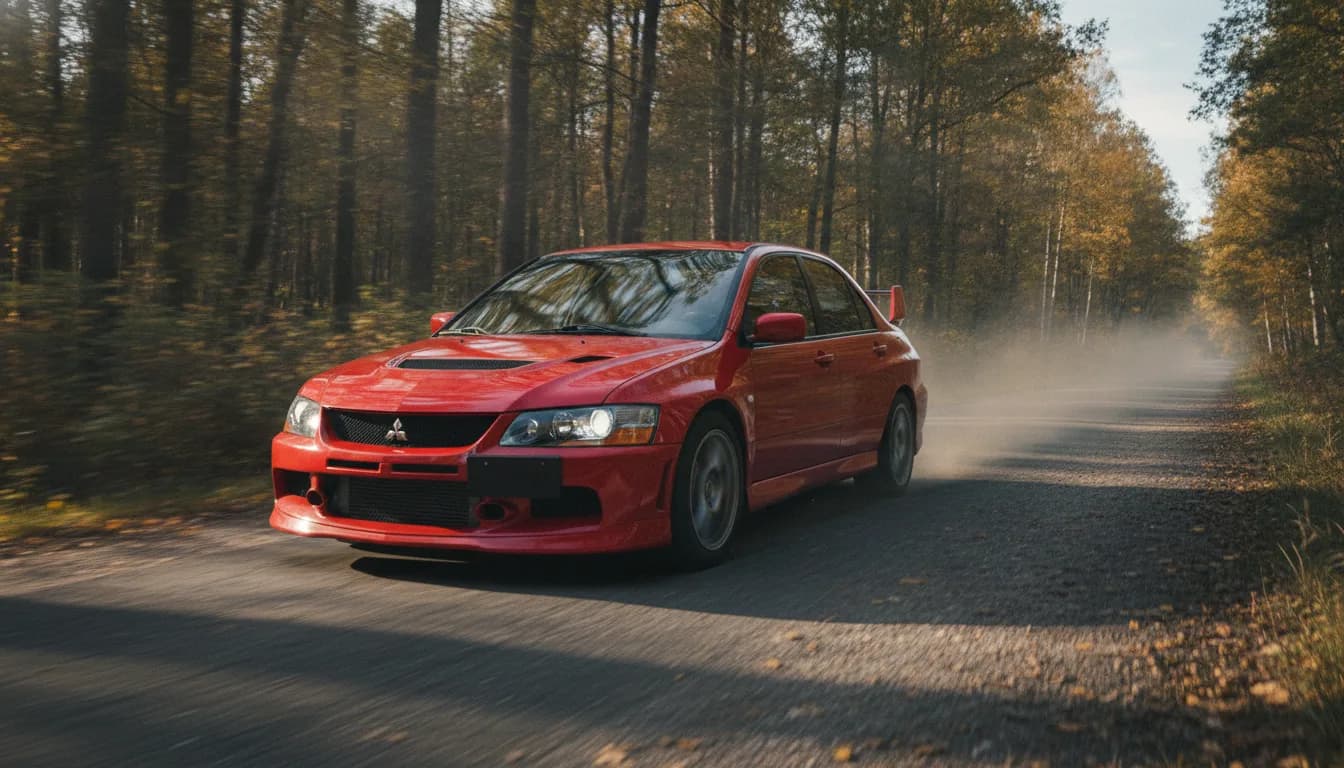
The TARMAC, GRAVEL and SNOW switch is the one part of the ACD system every Evo driver touches, and the one that collects the most myths. Some people never move it off TARMAC; others think SNOW is a kind of traction control. Here’s what Mitsubishi’s own manuals say the modes are for, what the switch can and can’t do, and what it means when the display starts misbehaving.
The modes tell the car what surface it’s on. Mitsubishi’s table is simple: TARMAC for dry paved roads, GRAVEL for wet roads and gravel, SNOW for snowy roads. The switch changes how the centre differential is controlled. It doesn’t switch four-wheel drive on or off, and it can’t fix a system that has no pressure.
What does each mode mean?
| MODE | ROAD SURFACE, PER MITSUBISHI |
|---|---|
| TARMAC | Dry paved roads |
| GRAVEL | Wet roads, gravel roads |
| SNOW | Snowy roads |
From Mitsubishi’s Evo VII technical information manual, where the ACD mode switch was introduced.
The one people get wrong is GRAVEL. It isn’t only for loose surfaces: the factory table puts wet roads under GRAVEL too.
What is the switch actually changing?
The ACD is a hydraulic clutch on the centre differential. The control unit squeezes it to tie the front and rear axles together, and releases it to let them turn freely. According to the manual, it does this continuously as you drive:
- Braking into a corner: the clutch tightens towards a locked four-wheel drive, for stability.
- Turning in: it releases, in step with how far and how fast you turn the wheel, so the car turns more easily.
- Accelerating out: it tightens again, in step with the throttle, for traction.
The mode you select is one of the inputs to that decision, alongside steering, throttle, wheel speeds and the G sensors. The manuals don’t publish how much lock each mode applies, so I won’t quote numbers. What they do make clear is the purpose: you’re telling the car how much grip to expect.
Does the mode change AYC too?
On the Evo VII–IX the manual calls it the ACD mode, and describes it only in terms of the centre differential. On the Evo X the name changes: it becomes the AWC control mode, a setting of the whole S-AWC system, which also runs AYC and uses the brakes for yaw control. The Evo X manuals I work from don’t spell out what each mode does to each part, so that’s as far as I’ll go.
What happens when I pull the handbrake?
The centre differential is released. The Evo VII manual states that if the parking brake is pulled above 5 km/h, the ACD clutch lets go and the centre differential is set as close to free as possible. That’s deliberate, and it happens whichever mode is selected.
What should the display do?
Evo VII–IX. Three lamps, one per mode. At ignition-on all three light for about a second and a half, then only the selected mode stays lit. Each press of the switch moves to the next mode.
Evo X. The selected mode is shown on the multi-information display.
What does it mean when all three lamps stay on?
A fault. On the Evo VII–IX, when ACD or AYC has a problem, all three mode lamps light and stay lit until the ignition is switched off. Both systems use the same three lamps, so the lamps alone don’t tell you which one it is; the fault codes do. They’re in Evo VII–IX codes 45, 46, 81 and 82.
On the Evo X, a fault brings up a service warning and the mode display goes off. That’s covered in Service Required 4WD.
When the lamps are all lit or the mode has disappeared, the switch has nothing to work with. Changing mode won’t bring the system back.
Why is the mode display flashing on my Evo X?
That one is different, and it isn’t a fault. The manual describes a flashing mode display as the control unit protecting the hardware after severe driving: it pauses control, flashes the display, and comes back when you switch the ignition off and on again. The earlier cars have the same protection without the flashing; it’s logged as codes 84 and 85, which the manual also says are not failures.
If it happens after a hard session, let the car cool and cycle the ignition. If it happens in ordinary driving, something is making the system work much harder than it should, and that’s worth looking into.
Does the mode matter if the pump is failing?
No. The modes only change how the pressure is used. If the pump can’t build pressure, there’s nothing to use, the control unit switches the system off and no mode will change that. The first things to check are in signs of ACD/AYC pump failure.
Parts for this job
All three lamps on, or the mode gone from the display? Send me the codes and I’ll tell you where I’d start.

