ACD/AYC Pump Noise: Whining, Grinding and a Pump That Won't Stop
By ACD/AYC PUMPS · UPDATED SEP 27, 2026
What a healthy ACD/AYC pump sounds like, and what whining, grinding or a pump that never stops tells you.

The ACD/AYC pump is supposed to make some noise. It's an electric motor driving a hydraulic pump, and you'll hear it working. The question owners of Evo VIII, IX and X ask me is where normal ends and trouble begins. The good news: the kind of noise tells you a lot about what's wrong, before you've even plugged in a scan tool.
What does a healthy pump sound like?
The pump doesn't run all the time. It charges an accumulator — a pressure reserve — and switches off once the system is up to pressure. The ECU knows when to stop from a pressure switch on the Evo VII–IX and a pressure sensor on the Evo X.
- When you switch on the ignition or start the car, you hear a short buzz for a few seconds while it charges, then silence.
- While driving it cuts in now and then to top up the pressure, more often when the system is working hard.
Short bursts, then silence — that's normal. The problems start when the rhythm changes or the sound does.
Pump runs too long or cycles too often
A good accumulator holds pressure for a long time, so the pump only needs short top-ups. If you hear it running much longer than a few seconds, or cutting in every few seconds at idle, the pressure is leaking away. The usual reasons are an accumulator that has lost its charge, an internal leak, or internal parts of the hydraulic section so worn that the pump can barely keep up.
This is the stage to act on. A pump that runs non-stop overheats its own motor and cooks its relay — that's exactly how a hydraulic problem turns into a dead motor. On the Evo X this often ends with code C161E and a Service Required warning.
Loud whine or buzz — and the fluid level drops
A pump that sucks air rather than fluid gets loud — a harsh whine or buzz. If the fluid level in the reservoir also falls over a few days, you have air in the circuit, a leak, or both. It's common right after a pump swap or line work without a proper bleed.
Fix the leak if there is one, top up with the correct ATF (SP III specification) and bleed the system — step by step in How to bleed the ACD/AYC system without MUT-III. If the noise comes back after a proper bleed, the pump itself is likely drawing air or failing.
Grinding or metallic noise
Grinding is the one you shouldn't ignore. It usually means a worn motor bearing, or the pump internals wearing against each other — when these pumps are opened up in that state, it's common to find metal debris inside. That debris goes round the circuit with the fluid.
You'll see advice online to grease the motor bearing. It can quieten a squeal for a while, but it doesn't fix worn parts. A grinding pump needs to come out and be rebuilt: new bearings, seals and worn hydraulic parts, then a bench test.
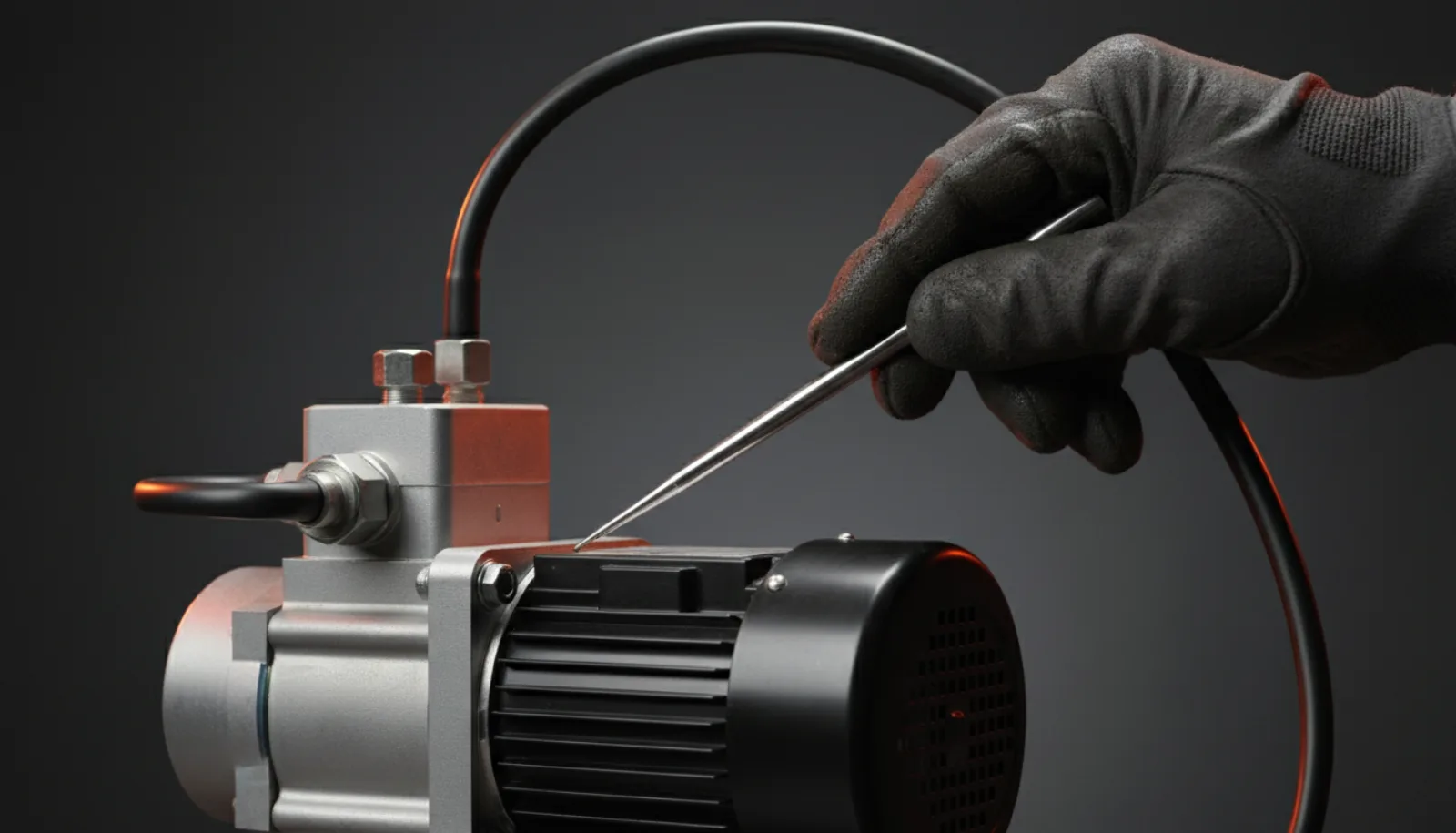
Pump never stops, even with the key out
A pump that keeps running after you switch off is almost always electrical: the pump relay has stuck closed, or the relay is getting a permanent signal. Don't leave it — it will flatten the battery and overheat the motor. Pull the pump relay or fuse to stop it, then check the relay and its wiring before you blame the pump.
Is it really the ACD/AYC pump?
Other parts of the car make similar noises, so rule them out first:
- Power steering pump. If the noise changes when you turn the steering wheel at a standstill, check the power steering first.
- Fuel pump. A short whine for a second or two when you switch the ignition on can simply be the fuel pump priming.
The easiest check is a mechanic's stethoscope, or a long screwdriver held to your ear, on the pump body while it runs.
Fault codes on the Evo VII–IX (AYC)
If your Evo VII–IX shows an ACD/AYC fault, these are the codes the AYC system stores. The ones that point at the pump itself are highlighted — 81, 82 and 83. Notice how many of the others are sensors: wheel speed, steering, throttle, acceleration. When any of them fails, the system switches the pump off, so a noisy or silent pump isn't always the pump's fault.
| CODE | FAULT |
|---|---|
| 12 | Power supply — open or short circuit |
| 13 | Fail-safe relay system fault |
| 21 | Front right wheel speed sensor — open or short circuit |
| 22 | Front left wheel speed sensor — open or short circuit |
| 23 | Rear right wheel speed sensor — open or short circuit |
| 24 | Rear left wheel speed sensor — open or short circuit |
| 25 | Wrong tyre diameter |
| 26 | Faulty wheel speed sensor |
| 31 | Steering sensor system (ST1, ST2, STN) — open circuit |
| 32 | Steering sensor STN — short circuit |
| 33 | Steering sensor STN system |
| 34 | Steering sensor ST1 / ST2 — short circuit |
| 41 | Throttle position sensor (TPS) — open or short circuit |
| 51 | Longitudinal acceleration sensor — open or short circuit |
| 52 | Longitudinal acceleration sensor |
| 56 | Lateral acceleration sensor — open or short circuit |
| 61 | Stop lamp switch system — open circuit |
| 65 | ABS monitor system — open or short circuit |
| 71 | Proportioning valve system — open or short circuit |
| 72 | Directional control valve, right — open or short circuit |
| 73 | Directional control valve, left — open or short circuit |
| 81 | AYC / pump relay system — open or short circuit |
| 82 | Electric pump system — pump malfunction or sensor failure |
| 83 | Electric pump system |
What to do next
- Run the ignition-on self-test from Signs of AYC pump failure and note how long the pump runs.
- Check the fluid level and look for leaks.
- Read the fault codes — on the Evo VII–IX use the table above, on the Evo X see codes C161E and C161C.
- If the pump itself is worn, it can almost always be rebuilt. We restore ACD/AYC pumps and load-test them before they ship — what that involves is in ACD pump restoration process. A failed core can go towards a restored unit through our trade-in programme.
Parts for this job
Pick your car — each link goes straight to the part:
Not sure what you're hearing? Message me — a short video with sound helps a lot.

